Lesson 5 - Start, Stop, Turn and Tight Turns
Purpose:
- The purpose of this lesson is to practice smooth acceleration, stopping, and positioning the SxS precisely while noticing how the suspension reacts. Participants will also learn the turning radius of an SxS and the difference between 2-wheel drive vs 4-wheel drive
Objectives:
- The participant will be able to identify and demonstrate the proper procedure for starting, stopping, turning, and tight turns. Participant will also demonstrate proper body position while the SxS is in motion; head up, thumbs out; all body parts remaining inside of the plane of the ROPS at all times.
Instructor Activities:
- ✅ Starting and stopping smoothly SEE: TECHNICAL INFORMATION LESSON 5 - Starting and Stopping Smoothly
- ✅ Positioning of SxS in turns. SEE: TECHNICAL INFORMATION LESSON 5 - Positioning SxS in Turns
- ✅ Driver input and suspension. SEE: TECHNICAL INFORMATION LESSON 5 - Driver Input and Suspension
- ✅ Steering SEE: TECHNICAL INFORMATION LESSON 5 - Steering
- ✅ Explain range setup
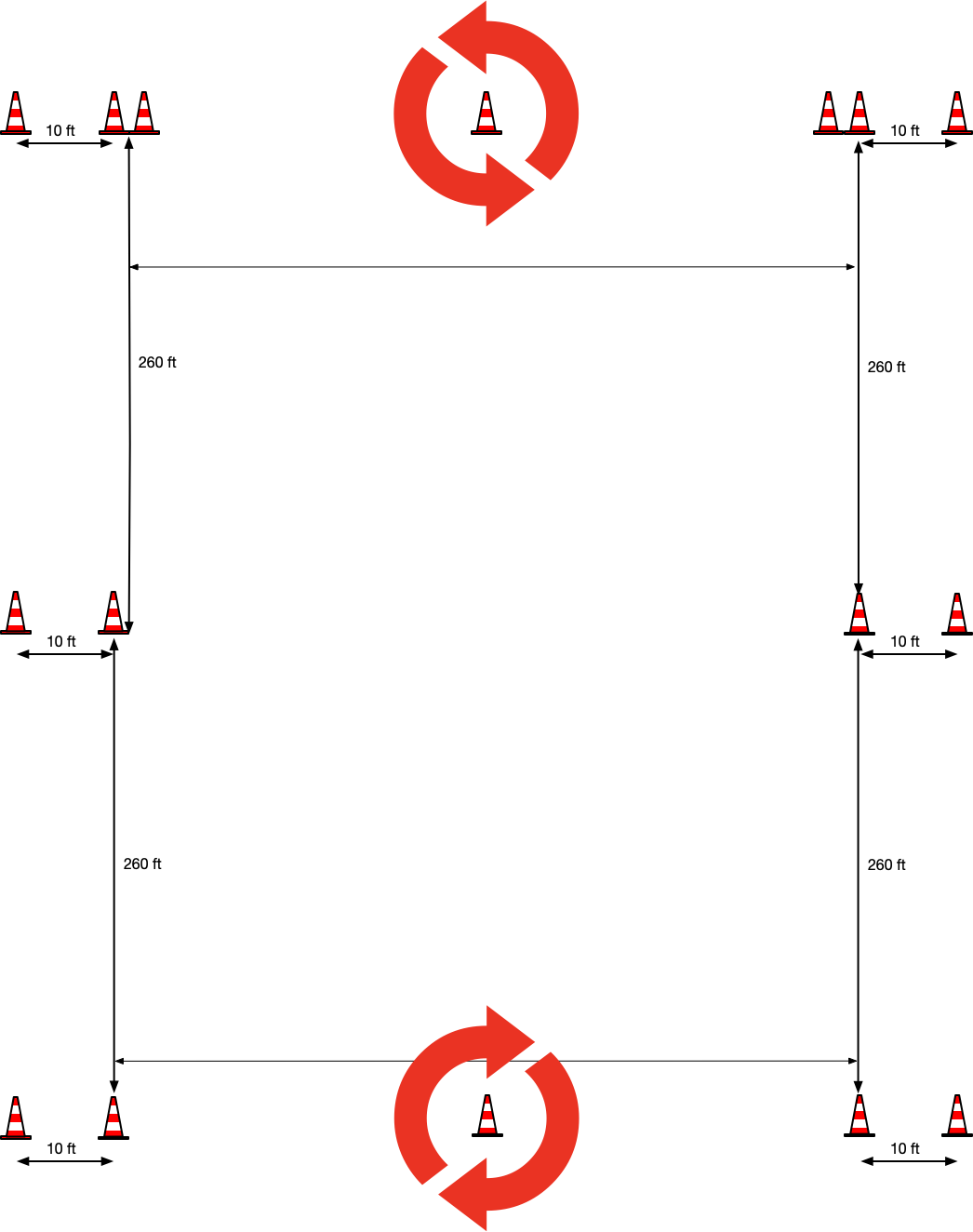
- Path of travel with several start and stop stations
- Some start/stops are in a straight line and others are in a turn
- In the middle area of this exercise are two circles, which will be used for the tight turns
- ✅ Provide Instructions:
- Drive to the first station in 2- wheel drive
- When the next station is open, drive to that station and stop. Continue when the SxS in front of you leaves for the next station
- Practice accuracy. Come to each station (stop) with your SxS centered between the cones
- When turning, practice hand-overhand or shuffle steering. Keep thumbs outside the wheel. Look where you want the SxS to go
- SxS go through turns differently depending on whether you are in 2-wheel drive or 4-wheel drive, in high or low range, what surface you are driving on, and how aggressively you use the accelerator. These different turning behaviors are sometimes described as understeer or oversteer
- Driving slowly around a turn, especially in 2-wheel drive, results in understeer-the front pushes to the outside of the turn and the
- SxS follows a larger radius going around the turn. Shifting into 4- wheel drive allows the front wheels to pull the SxS around the turn, creating oversteer and reducing the turning radius
- Using the accelerator/throttle aggressively causes the back of the SxS to slide to the outside of the turn, increasing oversteer and decreasing the turning radius even more
- Surfaces with different traction characteristics affect turning as well. The better the traction, the more the SxS will turn. Hardpacked dirt offers the most traction, enough to create centrifugal force and cause an SxS to roll over in turns. Deep sand or gravel offers the least traction. Selecting 4-wheel drive ahead of time and using the accelerator aggressively helps the SxS to turn but timing is important
- Approach and drive around the circle slowly with the wheel turned all the way (full-lock) to the right. Complete one revolution once completed continue to the next station
- After final stop station, return to the end of the line and repeat but in 4-wheel drive this time
- Repeat exercise in a clockwise direction in both 2-wheel drive and 4-wheel drive
- ✅ Conduct demonstration of lesson (counterclockwise only) in 2-wheel drive. No 4-wheel drive demo is needed
- ✅ Provide evaluation
- Low, controlled speed
- Thumbs outside steering wheel
- Wheels on ground at all times
- Use full-lock steering - tight turns
- Keeps head and eyes up and look through path of travel
- Keeps SxS from sliding/lifting
- ✅ Conduct lesson
- ✅ Have participants stay in SxS until all drivers have parked (staged)
Assessment:
- 👆 Where should your body be when riding in an SxS?
- 👆 Where should you look while turning?
- 👆 Why is operating an SxS on high-traction surfaces potentially dangerous?
- 👆 Where do you look while completing a tight turn?
Range Diagram